Extract intervals from "mnirs" time series data, specifying interval start and end boundaries by time value, event label, lap number, or sample index.
Arguments
- data
A data frame of class "mnirs" containing time series data and metadata, or a
list()of such data frames.- nirs_channels
A character vector of mNIRS channel names to operate on. Names must match column names in
dataexactly.If
NULL(default), channels are retrieved from "mnirs" metadata.![[Deprecated]](figures/lifecycle-deprecated.svg) Passing a
Passing a list()for per-group channel selection is deprecated; usegroup_channels.
- time_channel
A character string naming the time or sample column. Must match a column name in
dataexactly.If
NULL(default), thetime_channelmetadata attribute ofdatais used.
- event_channel
An optional character string giving the name of an event/lap column. The column may contain character event labels or integer lap numbers.
Required when using
by_label()orby_lap()forstartorend.Retrieved from metadata if not defined explicitly.
- sample_rate
An optional numeric sample rate (Hz) used to bin time values for ensemble-averaging. If
NULL, will be estimated fromtime_channel(see Details).- group_intervals
Either a character string or a non-empty
list()of non-empty integer-valued numeric vectors specifying how to group intervals (see Details). Custom indices must be between1and the number of detected intervals."distinct"The default. Extract each interval as an independent data frame.
"ensemble"Ensemble-average each specified
nirs_channelacross all detected intervals, returning a single data frame.list(c(1, 2), c(3, 4))Ensemble-average each specified
nirs_channelwithin each group and return one data frame per group.
- group_channels
A character vector or a
list()of character vectors selecting whichnirs_channelsare ensemble-averaged within each interval group (see Details).If
NULL(default), allnirs_channelsare used for every group.Only relevant when
group_intervalscontains "ensemble"-averaged intervals; withgroup_intervals = "distinct"no channel processing occurs.
- start
Specifies where intervals begin. Either raw values – numeric for time values, character for event labels, explicit integer (e.g.
2L) for lap numbers – or created withby_time(),by_label(),by_lap(), orby_sample(). Multiple specifications can be combined withlist()(e.g.list(by_time(30), by_label("go"))); see Details.- end
Specifies where intervals end. Either raw values – numeric for time values, character for event labels, explicit integer (e.g.
2L) for lap numbers – or created withby_time(),by_label(),by_lap(), orby_sample(). Multiple specifications can be combined withlist()(e.g.list(by_time(30), by_label("go"))); see Details.- span
A one- or two-element numeric vector expanding the time bounds around
c(start, end), in units oftime_channel; or alist()of such vectors. (defaultspan = c(-60, 60). Applied additively to interval boundaries:When both
startandendare specified:span[1]shifts start times,span[2]shifts end times.When only
startor onlyendis specified: bothspan[1]andspan[2]apply as a window around the event).A single positive value is recycled to shift the end times (e.g.
span = 60->c(0, 60)).A single negative value is recycled to shift the start times (e.g.
span = -60->c(-60, 0)).
- zero_time
Logical. Default is
FALSE. IfTRUE, re-calculates numerictime_channelvalues to start from zero within each interval data frame.- verbose
Logical.
TRUE(default) will display, andFALSEwill silence warnings and information messages helpful for troubleshooting. Global default can be set viaoptions(mnirs.verbose = FALSE).- event_groups
- Renamed to
group_intervalsfor naming consistency across the package.
Value
A named list() of tibbles of class
"mnirs", each with metadata available via attributes(). When data
is a list of data frames, results are flattened into a single-layer
list with interval names indicating nested number of data frame and
interval as interval_<df>.<interval>. Other interval names (e.g.
"ensemble" or custom group names) are suffixed as <name>_<df>.
Details
Interval specification
Interval start and end boundaries are specified using helper functions,
or by passing raw values directly:
by_time()Time values in units of
time_channel.by_label()Strings to match in
event_channel. All matching occurrences are returned.by_lap()Lap numbers to match in
event_channel. Resolves to the first sample of each lap forstart, and the last lap sample forendby_sample()Integer sample indices (row numbers).
Raw values supplied to start/end are auto-coerced:
Numeric ->
by_time()Character ->
by_label(),Explicit integer (e.g.
2L) ->by_lap().Use
by_sample()explicitly for sample indices.
start and end can use different specification types (e.g., start by
label, end by time). When lengths differ, the shorter is recycled.
Multiple specification types can be combined for a single boundary with
list() (e.g. start = list(by_time(30), by_label("go"))).
Resolved boundary times are concatenated in the order supplied. Combined
specifications must use the by_ helpers directly: raw values are ignored
with a warning.
Time span window
span additively expands the time span window around interval boundaries.
A two-value vector expands the
startandend, respectively:span = c(-60, 60)expands thestartearlier by60, and theendlater by60. For example,start = by_time(30), end = by_time(60), span = c(-5, 10)returns an interval of[25, 70].A single numeric value is recycled according to the sign:
span = -60becomesc(-60, 0)to expand thestartearlier.span = 60becomesc(0, 60)to expand theendlater.If only
startis specified alone, both span values expand the single boundary window:start = by_time(30), span = c(-5, 60)returns[25, 90].
Per-group channel selection with group_channels
When group_intervals = "ensemble" or a list of numeric grouped intervals,
group_channels can be specified as a list of column names to override
which channels are ensemble-averaged within each group. For example, to
exclude a channel from one interval:
group_channels = list(
  c(A, B, C),
  c(A, C) ## channel "B" data are excluded from the second interval
)
If all grouped intervals include all nirs_channels, group_channels can
be left as NULL (the default) and all channels are ensemble-averaged
within every group.
Grouping intervals
group_intervals controls whether extracted intervals are returned as
distinct data frames or ensemble-averaged.
"distinct"The default. Extract each interval and return a list of independent data frames.
"ensemble"Ensemble-average each specified
nirs_channelacross all detected intervals and return a one-item list with a single data frame.list(c(1, 2), c(3, 4))Ensemble-average each specified
nirs_channelwithin each group and return a list with one data frame for each group. Any intervals detected but not specified ingroup_intervalsare returned as distinct.
group_intervals lists can be named (e.g.
list(low = c(1, 2), high = c(3, 4))) and will pass those names to the
returned list of data frames.
When group_intervals is a list of numeric interval numbers, list items in
group_channels and span are recycled to the number of groups. If lists
are only partially specified, the final item is recycled forward as needed.
Extra items are ignored.
Examples
## read example data
data <- read_mnirs(
example_mnirs("train.red"),
nirs_channels = c(
smo2_left = "SmO2 unfiltered",
smo2_right = "SmO2 unfiltered"
),
time_channel = c(time = "Timestamp (seconds passed)"),
zero_time = TRUE,
verbose = FALSE
) |>
## avoid issues ensemble-averaging irregular samples
resample_mnirs(method = "linear", verbose = FALSE)
## ensemble-average across multiple intervals
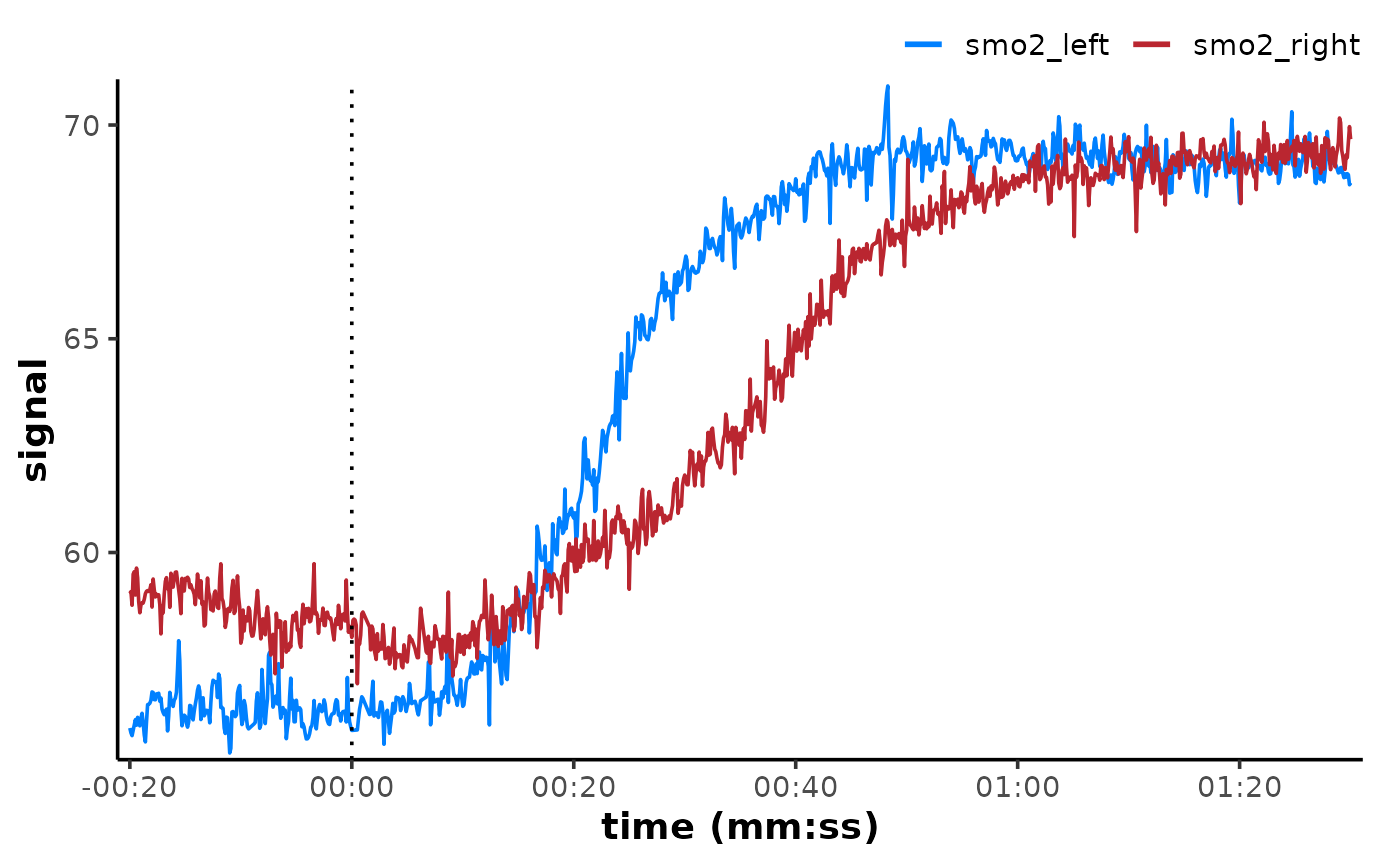
interval_list <- extract_intervals(
data, ## channels recycled to all intervals by default
nirs_channels = c(smo2_left, smo2_right),
group_intervals = "ensemble", ## ensemble-average across two intervals
start = by_time(368, 1084), ## manually identified interval start times
span = c(-20, 90), ## include the last 180-sec of each interval (recycled)
zero_time = TRUE ## re-calculate common time to start from `0`
)
interval_list[[1L]]
#> # A tibble: 1,101 × 4
#> time `Lap/Event` smo2_left smo2_right
#> <dbl> <int> <dbl> <dbl>
#> 1 -20 2 56.3 59.2
#> 2 -19.9 2 56.1 59.2
#> 3 -19.8 2 56.1 59.2
#> 4 -19.7 2 56.2 58.9
#> 5 -19.6 2 56.4 58.9
#> 6 -19.5 2 56.5 58.9
#> 7 -19.4 2 56.9 58.7
#> 8 -19.3 2 57.0 58.7
#> 9 -19.2 2 56.9 59.0
#> 10 -19.1 2 56.7 58.8
#> # ℹ 1,091 more rows
# \donttest{
if (requireNamespace("ggplot2", quietly = TRUE)) {
plot(interval_list, time_labels = TRUE) +
ggplot2::geom_vline(xintercept = 0, linetype = "dotted")
}
 # }
# }